Trump, Carney, and Sheinbaum Unite at World Cup 2026 Draw: Historic Moment of Tri-Nation Diplomacy
Historic Attendance Overview
World Leaders Present
Tri-Nation World Cup
Draw Ceremony Date
Ceremony Location
🤝 The Three Host Nation Leaders
🇺🇸 UNITED STATES: President Donald Trump
🇨🇦 CANADA: Prime Minister Mark Carney
🇲🇽 MEXICO: President Claudia Sheinbaum
SIGNIFICANCE: First time all three host nation leaders have appeared together for a World Cup event
A Moment of Unity Amid Complex Relations
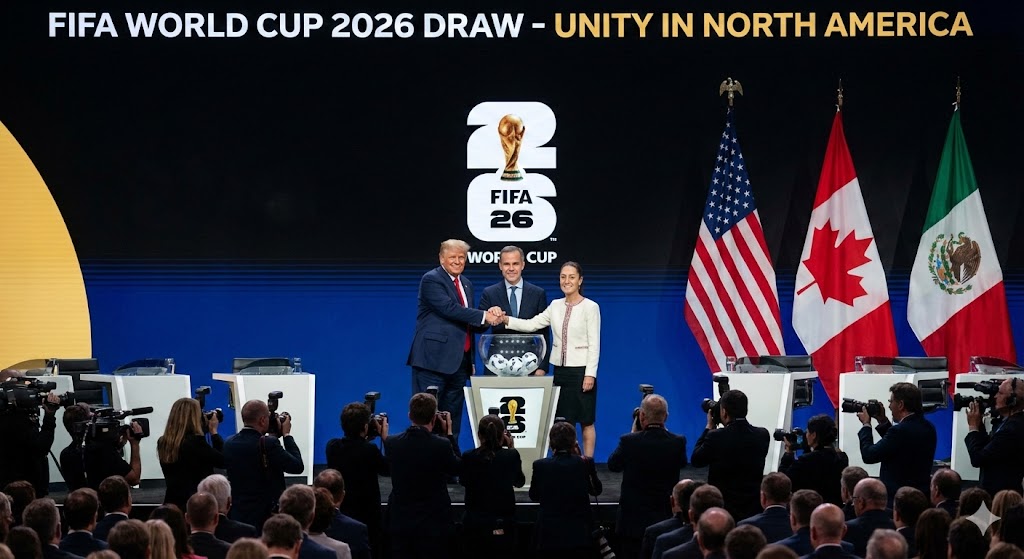
The joint appearance of President Trump, Prime Minister Carney, and President Sheinbaum at the World Cup Draw sent a powerful message about the unifying power of sport. Despite the complex diplomatic relationships and ongoing negotiations between the three neighboring nations on issues ranging from trade to immigration, the leaders came together to celebrate their shared role as hosts of the world’s biggest sporting event.
The Kennedy Center, one of America’s most prestigious cultural venues, provided a fitting backdrop for this display of continental cooperation. As the draw ceremony revealed the 48 teams and 12 groups that will compete across all three nations in summer 2026, the presence of all three leaders underscored the unprecedented collaborative effort required to stage the largest World Cup in history.
Host Cities: 11 U.S. venues including MetLife Stadium (Final), SoFi Stadium, AT&T Stadium
Significance: Hosting ceremony in Washington D.C. as primary host nation with most matches
Context: The 2026 World Cup represents a major moment for American soccer and global sports diplomacy
Host Cities: Toronto (BMO Field) and Vancouver (BC Place)
Significance: Canada hosting World Cup matches for the first time in history
Context: Represents Canada’s growing football culture and successful 2022 World Cup qualification after 36-year absence
Host Cities: Mexico City (Estadio Azteca), Guadalajara, Monterrey
Significance: Mexico hosting World Cup for record third time (1970, 1986, 2026)
Context: First female president of Mexico, representing nation with deep football heritage
Football as a Bridge for Diplomacy
The World Cup has long served as a platform for diplomatic engagement, and the 2026 tournament represents perhaps the most ambitious example of international sports cooperation ever attempted. The tri-nation bid, which was awarded by FIFA in 2018, required years of coordination between three governments with sometimes divergent interests and priorities.
The presence of all three leaders at the draw ceremony demonstrated that despite political differences, the shared commitment to delivering a successful World Cup transcends partisan divides. The tournament will require seamless coordination on security, transportation, immigration, and infrastructure across three countries with distinct systems and approaches.
🌎 Tri-Nation Cooperation Requirements
The Symbolic Power of the Joint Appearance
Political analysts and sports diplomacy experts noted the significance of the three leaders appearing together at a time when North American relations face various challenges. Trade negotiations, immigration policy, and energy cooperation remain ongoing topics of discussion between the three governments, making the unified World Cup front all the more notable.
The optics of Trump, Carney, and Sheinbaum sitting together, applauding as their nations’ teams were drawn into groups, and celebrating the tournament’s approaching reality, sent a message that transcended the typical political discourse. For one evening, the focus was on what unites North America rather than what divides it.
Historical Context: World Cups and World Leaders
The tradition of heads of state attending World Cup events dates back decades, but a tri-nation appearance is unprecedented. Previous World Cup ceremonies have featured individual host nation leaders, but never before have three sitting heads of government from different countries appeared together to launch a jointly hosted tournament.
2010 South Africa: Nelson Mandela’s appearance became iconic moment
2014 Brazil: President Dilma Rousseff faced mixed reception
2018 Russia: President Vladimir Putin hosted global leaders
2022 Qatar: Emir Tamim bin Hamad Al Thani presided over opening
Geographic Scale: Largest geographic footprint of any World Cup
Economic Integration: USMCA partners collaborating on sporting event
Cultural Bridge: English, Spanish, and French-speaking nations united
Political Statement: Joint appearance defies expectations of division
The Draw Ceremony Setting
The John F. Kennedy Center for the Performing Arts provided an elegant and symbolically significant venue for the draw ceremony. As America’s national cultural center, the Kennedy Center represented the artistic and cultural dimensions of the World Cup while offering a prestigious setting befitting an event attended by three heads of government.
🎭 Kennedy Center Ceremony Details
Security and Protocol Considerations
The attendance of three heads of government at a single event required extraordinary security coordination between the U.S. Secret Service, Royal Canadian Mounted Police, and Mexican Presidential Security. The Kennedy Center was transformed into one of the most secure venues in the world for the evening, with multiple security perimeters and comprehensive screening protocols.
The successful execution of security for the draw ceremony also served as a preview of the coordination required during the tournament itself, when VIPs, heads of state, and celebrities will attend matches across 16 cities in three countries over the course of five weeks.
Coordination: Joint operations center with Canadian and Mexican counterparts
Perimeter: Multiple security zones around Kennedy Center
Screening: Advanced screening for all attendees and staff
Motorcade: Coordinated arrival and departure of three leaders
Final Match: MetLife Stadium will require similar multi-national coordination
Cross-Border: Protocols established for protecting VIPs traveling between countries
Communication: Secure channels between three nations’ security services
Lessons Learned: Draw ceremony experience informs tournament planning
Looking Ahead: The Tournament and Beyond
The joint appearance of Trump, Carney, and Sheinbaum at the draw ceremony sets the stage for continued cooperation as the tournament approaches. All three leaders are expected to attend various matches during the World Cup, with the opening ceremony at Estadio Azteca and the final at MetLife Stadium likely to feature similar tri-national leadership presence.
Beyond the tournament itself, the successful collaboration required to host the 2026 World Cup could establish new frameworks for North American cooperation on future large-scale events and initiatives. The relationships built through World Cup planning may create lasting channels for diplomatic engagement on other issues.
Key Upcoming Moments for Host Nation Leaders
The Power of Sports Diplomacy
The image of three North American leaders united by football resonates beyond the sporting world. In an era of political polarization and international tensions, the World Cup offers a reminder that shared experiences can bridge divides. The 2026 tournament, born from a bold tri-nation bid, now carries the hopes of three countries and the expectations of billions of football fans worldwide.
As President Trump, Prime Minister Carney, and President Sheinbaum demonstrated at the draw ceremony, the beautiful game has the power to bring together even the most complex of neighbors. Whatever challenges arise in North American relations over the coming months and years, the 2026 World Cup stands as a testament to what the three nations can achieve when they work together toward a common goal.
The historic joint appearance of President Donald Trump, Prime Minister Mark Carney, and President Claudia Sheinbaum at the World Cup 2026 Draw represented more than a photo opportunity – it was a powerful statement about North American unity and the unifying power of the world’s most popular sport.
As the three host nations prepare to welcome the world in summer 2026, the image of their leaders standing together at the Kennedy Center will endure as a symbol of what the tri-nation World Cup represents: collaboration over competition, unity over division, and the shared belief that together, the United States, Canada, and Mexico can deliver the greatest World Cup in history. The draw ceremony was just the beginning – the real test of this unprecedented partnership begins when the first whistle blows at Estadio Azteca on June 11, 2026.