
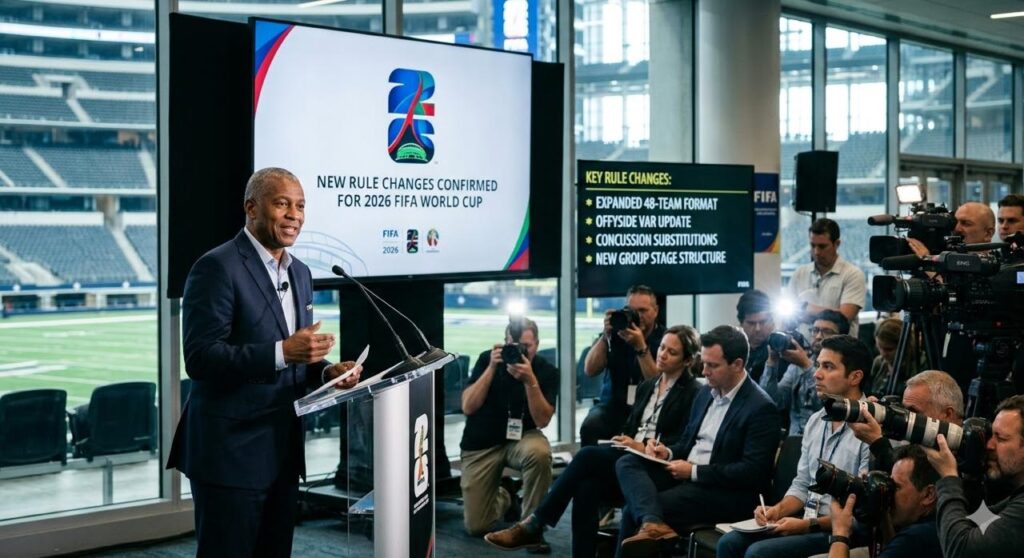
New Rule Changes Confirmed for 2026 FIFA World Cup
Rule Changes at a Glance
Seconds for Throw-ins
Seconds to Sub Off
Seconds Off for Injury
Major Changes
The Big Changes
These rule updates represent some of the most significant modifications to the Laws of the Game in recent years. FIFA has been working closely with IFAB to address long-standing frustrations among fans, players, and coaches — particularly around time-wasting and VAR limitations.
⏱️ 5-Second Countdown for Throw-ins & Goal Kicks
In one of the most impactful changes, players will now have just five seconds to put the ball back in play on throw-ins and goal kicks. If they fail to do so, possession will be awarded to the opposing team. This is a direct response to the persistent time-wasting that has plagued the modern game.
📹 Expanded VAR Powers
The Video Assistant Referee (VAR) system will receive expanded powers to review clear errors involving second yellow cards and wrongly awarded corner kicks — two areas that have previously been outside VAR’s scope. This should reduce controversial moments that have marred recent tournaments.
🩺 Injury Simulation Crackdown
Players who stop play due to injury must now remain off the field for at least one minute after the match restarts. This rule is designed to discourage players from faking or exaggerating injuries to break up the flow of play — a tactic that has frustrated fans for decades.
🔄 Faster Substitutions
Substituted players will be required to leave the pitch within 10 seconds, putting an end to the slow, drawn-out walks to the sideline that eat up valuable match time. No more standing ovations that last longer than the player’s actual contribution.
✅ Advantage Play Update
If a referee plays advantage after a foul and a goal is subsequently scored, the fouling player will no longer receive an automatic yellow card. This encourages referees to let play continue without the fear of “double punishment” and rewards attacking play.
📷 Referee Body Cameras
Referees will be permitted to wear body cameras during matches, offering fans and officials an unprecedented perspective on in-game decisions and interactions. This could revolutionize how we understand referee decision-making.
Why These Changes Matter
Time-wasting has been one of the biggest complaints in modern football. According to FIFA’s own analysis, the average World Cup match in 2022 had just 58 minutes of actual ball-in-play time. These new rules aim to push that number significantly higher, giving fans more of what they pay to see — actual football.
🎯 Goals of the Rule Changes
What Stays the Same
⚽ Unchanged Rules
Key Dates to Remember
Road to the 2026 World Cup
The beautiful game is about to get faster, fairer, and more exciting.
With 104 matches across 16 venues in three countries, the 2026 FIFA World Cup will be the ultimate test for these new rules. Whether you’re watching from the stands or streaming from home, expect a World Cup like no other.
The countdown to June 11 continues. ⚽🏆
📅 Explore the Full Tournament Schedule
Plan your World Cup experience now. Check out our interactive Schedule Navigator to browse all 104 matches with dates, venues, and kick-off times — from the June 11 opener to the July 19 Final.